

Why You Keep Thinking About Your Ex (Even When You Don’t Want To)
Understand why you keep thinking about your ex. Learn what happens in your brain and body, and how to begin healing.
Chapter Summary
It’s incredibly frustrating when thoughts of your ex invade your mind, especially when all you want is to move on. You might feel confused or even guilty for these persistent memories. This isn’t a sign of weakness; it’s a perfectly normal response from your brain. Your mind naturally revisits significant emotional experiences, trying to process and make sense of what happened, even if it feels unwelcome.
This chapter will illuminate the powerful reasons behind your persistent thoughts, delving into emotional memory and why your mind seeks answers. You will discover why memories often surface at night and understand that these thoughts do not mean you should return to the relationship. By the end, you’ll learn effective strategies to respond when these thoughts appear and how to gently redirect your attention.
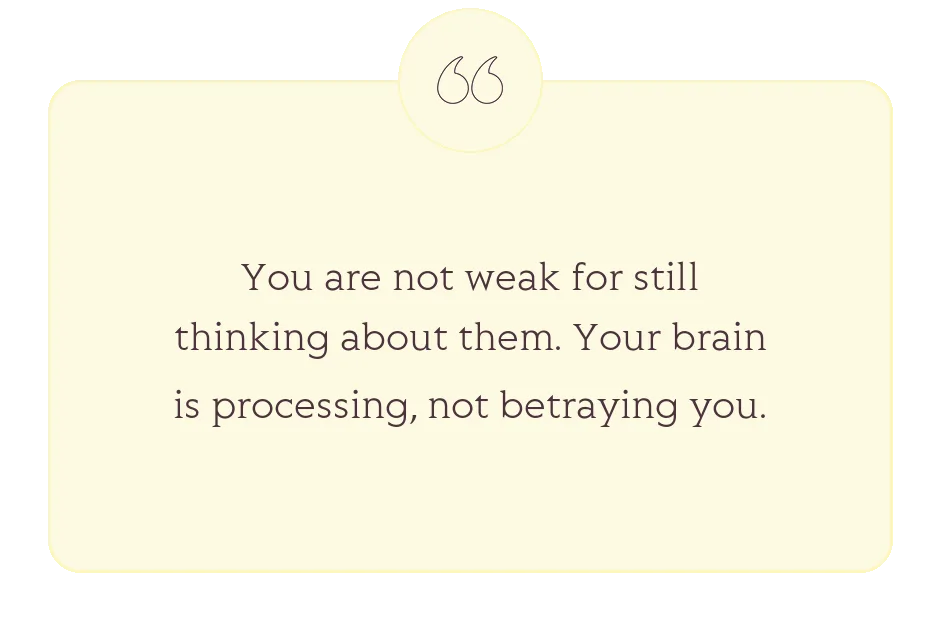
Why You Keep Thinking About Your Ex (Even When You Don’t Want To)
One of the most frustrating parts of heartbreak is how often your mind returns to your ex.
You might be trying to focus on work, a conversation, or even something enjoyable, and suddenly a memory appears. A conversation replays. A moment resurfaces.
Sometimes it happens dozens of times a day.
(It can feel like your brain has accidentally set your ex as its default background tab.)
You may find yourself wondering:
“Why am I still thinking about them?”
“Why can’t I stop replaying everything?”
“Why does my brain keep going back there?”
If this is happening to you, it doesn’t mean you’re stuck or that something is wrong with you.
It means your brain is still processing the emotional bond that once existed.
Understanding why these thoughts happen can make them feel less overwhelming, and help you move through them with a little more patience toward yourself.
Why Your Brain Keeps Returning to the Relationship
Romantic relationships create strong emotional and neurological patterns in the brain.
You might also find it helpful to read: Why You Keep Replaying the Relationship in Your Head After a Breakup.
When you spend time with someone consistently, your mind forms associations between that person and many aspects of daily life.
Over time, your ex may become linked to:
- routines
- places
- songs
- habits
- future plans
- emotional comfort
When the relationship ends, those connections don’t immediately disappear.
Instead, your brain continues referencing the relationship as part of its emotional map.
This is why thoughts about your ex can appear automatically, even when you don’t consciously want them to.
(Your brain hasn’t fully updated the emotional GPS yet.)

The Role of Emotional Memory
Emotional experiences are stored more deeply in memory than ordinary events.
You might also find it helpful to read: Why You Romanticise Your Ex After a Breakup (And Forget the Bad Parts).
Moments connected to love, conflict, excitement, or vulnerability often become particularly vivid.
Because of this, your brain may replay certain moments repeatedly as it tries to understand what happened.
Common mental loops include:
- replaying the breakup conversation
- analysing what went wrong
- imagining different outcomes
- wondering what your ex is doing now
These loops are part of the brain’s attempt to process the loss of a meaningful connection.
While they can feel exhausting, they are also a sign that your mind is trying to make sense of the experience.
Why Your Mind Searches for Answers
After a breakup, many people feel an intense need to understand why the relationship ended.
Your mind may search for answers like:
“Did I do something wrong?”
“Could I have fixed this?”
“Did they ever really love me?”
This searching behaviour is connected to the brain’s need for closure and predictability.
When something emotionally significant ends suddenly or without clear explanation, the mind often revisits the experience repeatedly in an attempt to make sense of it.
(It’s essentially your brain trying to finish a story that feels incomplete.)
Why Memories Often Appear at Night
Many people notice that thoughts about their ex become stronger at night.
This is partly because the brain has fewer distractions once the day ends.
During the day, your attention is divided between tasks, conversations, and responsibilities.
At night, when things become quieter, your mind has more space to process unresolved emotions.
This is why memories, questions, and longing can sometimes feel louder in the evening.
(It’s also why your brain occasionally decides that 11:47pm is the perfect time to replay your entire relationship history.)
Why Thinking About Your Ex Doesn’t Mean You Should Go Back
It’s important to remember that thinking about someone is not the same as needing them in your life.
Your brain may replay memories simply because the relationship was emotionally meaningful.
You can miss someone and still recognise that the relationship was not right for you.
Over time, as your brain forms new experiences and emotional associations, the frequency of these thoughts usually decreases.
Memories may still appear occasionally, but they tend to carry less emotional intensity.
How to Respond When Thoughts Appear
Trying to force yourself not to think about your ex can sometimes make the thoughts stronger.
Instead, a gentler approach often works better.
Acknowledge the thought without engaging it
You might notice the thought and simply say to yourself:
“That memory appeared. It will pass.”
Sometimes naming the experience is enough to reduce its intensity.
Redirect your attention
Shift your focus toward something present, a conversation, movement, or a simple task.
This helps your brain reconnect with the current moment rather than staying stuck in the memory.
Create new routines
As new experiences fill your life, your brain begins building fresh emotional associations that gradually replace the old ones.
Over time, the emotional pathways connected to your ex become less dominant.
The Gradual Quieting of the Mind
In the early stages of heartbreak, thoughts about your ex may feel constant.
But with time, something subtle begins to change.
You may notice:
- the thoughts appear less frequently
- they carry less emotional intensity
- they pass more quickly when they arise
This shift often happens slowly, sometimes so gradually that you barely notice it.
But it’s a strong sign that your brain is adapting and healing.
(Sometimes healing looks like realising you went several hours without thinking about them, and that used to feel impossible.)
Frequently Asked Questions
Why can’t I stop thinking about my ex? Your brain is processing the loss of an emotional bond that once played an important role in your daily life. This adjustment takes time.
Is it normal to think about your ex months after a breakup? Yes. Emotional memories can remain active long after a relationship ends, especially if the relationship was meaningful.
Does thinking about my ex mean I still love them? Not necessarily. Thoughts about an ex often reflect emotional processing rather than ongoing romantic feelings.
Will the thoughts eventually stop? For most people, thoughts about an ex gradually become less frequent and less emotionally intense as new experiences and routines develop.
Why do I think about my ex more when I’m alone? When distractions are limited, the mind often turns toward unresolved emotional experiences.