

Why You Keep Replaying the Relationship in Your Head After a Breakup
Understand why you keep replaying the relationship in your head after a breakup. Learn what happens in your brain and body, and how to begin healing.
Chapter Summary
It is completely normal to find yourself endlessly replaying every moment of your past relationship, dissecting conversations, and agonizing over what went wrong. This intense mental loop, a common and painful part of heartbreak, is your brain’s natural attempt to process loss and make sense of a significant shift in your life. You are not alone in this experience; it is a fundamental way your mind tries to cope with emotional upheaval and find closure.
This chapter will delve into the psychological reasons behind your brain’s relentless search for meaning, distinguishing between healthy reflection and harmful rumination. You will learn why “what if” questions dominate your thoughts, especially at night, and discover the brain’s natural process for moving forward. By the end, you will understand tangible strategies to break the rumination cycle and begin healing.
Why You Keep Replaying the Relationship in Your Head After a Breakup
After a breakup, many people notice the same thing happening again and again.
Their mind keeps replaying the relationship.
You might find yourself revisiting:
- conversations you had
- arguments you wish had gone differently
- moments where something suddenly felt “off”
- things you wish you had said
Sometimes it can feel like your brain is running through the same memories on a loop.
You may even catch yourself analysing tiny details, wondering whether a different choice might have changed the outcome.
This mental replay can be exhausting.
And when it keeps happening, many people start wondering if something is wrong with them.
But this experience is actually very common after the end of an important relationship.
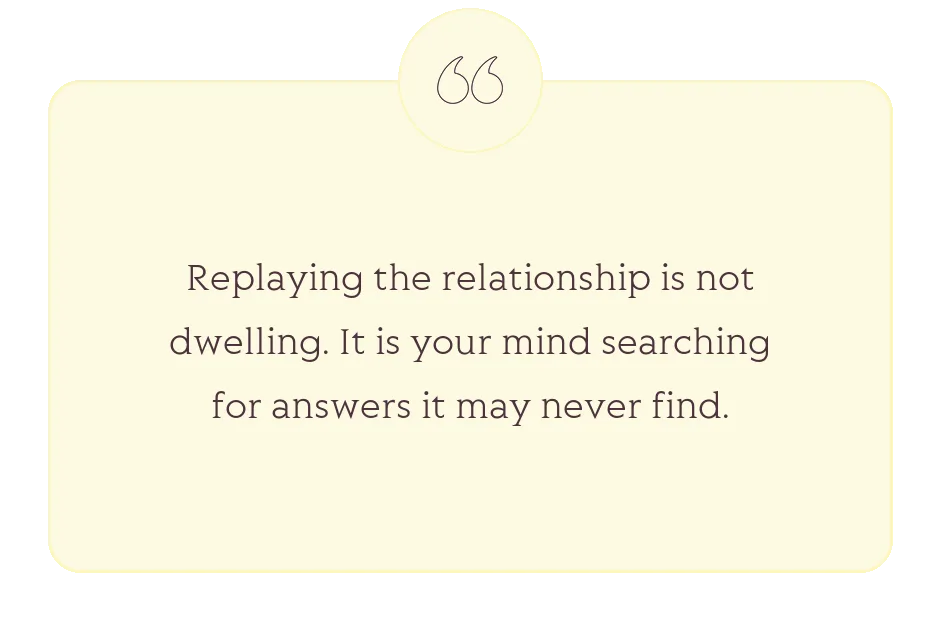
In many ways, your brain is simply trying to understand what happened.
Why the Brain Searches for Meaning After a Breakup
Humans are naturally wired to look for patterns and explanations when something significant ends.
You might also find it helpful to read: Why Your Brain Replays the Relationship at Night.
When a relationship finishes, your brain often tries to organise the experience into a clear narrative.
Questions may start appearing, such as:
- “When did things start changing?”
- “Did I miss any signs?”
- “Could I have prevented this?”
Replaying memories can be part of the brain’s attempt to answer these questions.
Your mind is looking for closure, clarity, and understanding.
When something emotionally important ends without clear answers, the brain may continue searching for meaning.

The Difference Between Reflection and Rumination
Thinking about a past relationship can sometimes be helpful.
You might also find it helpful to read: Why You Romanticise Your Ex After a Breakup (And Forget the Bad Parts).
Reflecting on experiences can lead to insights about:
- communication patterns
- emotional needs
- compatibility
- relationship dynamics
This type of reflection can help people grow and develop healthier relationships in the future.
However, when thoughts repeat without producing new understanding, the process can shift into rumination.
Rumination often involves:
- replaying the same events repeatedly
- focusing heavily on what went wrong
- imagining alternative outcomes
- analysing the past without reaching resolution
Instead of producing clarity, rumination can keep emotional wounds active.
Why Your Brain Focuses on “What If” Questions
One reason the mind replays the relationship is because it is searching for missing information.
The brain may begin imagining alternative versions of the past, asking questions such as:
- “What if I had said something different?”
- “What if we had tried harder?”
- “What if I misunderstood something?”
These “what if” scenarios are part of how the mind explores possible explanations.
Your brain is trying to learn from the experience.
But because the past cannot be rewritten, repeatedly revisiting these possibilities rarely produces new answers.
Why Overthinking Is Often Stronger at Night
Many people notice that rumination becomes more intense late at night.
There are a few reasons for this.
Nighttime often provides fewer distractions.
Without work, conversations, or daily responsibilities, the mind has more space to wander through emotional memories.
Fatigue can also make emotional regulation more difficult, which can allow intrusive thoughts to feel more powerful.
This is why your brain might suddenly decide that 2am is the perfect time to reanalyse a conversation from six months ago.
(It rarely is.)
How the Brain Eventually Moves Forward
Although rumination can feel overwhelming, the brain gradually processes emotional experiences over time.
As new routines and experiences develop, your mind slowly begins focusing less on analysing the past.
Instead, attention begins shifting toward present experiences and future possibilities.
This transition often happens quietly.
One day you may notice that the memories appear less frequently.
Or when they do appear, they feel less emotionally intense.
These subtle changes often signal that your brain is slowly integrating the experience.
What Helps Break the Rumination Loop
When your mind becomes stuck replaying the relationship, certain strategies can help interrupt the cycle.
Redirect your attention
Activities that require focus, such as exercise, creative work, or social connection, can help shift the brain away from repetitive thought patterns.
Write your thoughts down
Journaling can help organise the questions and reflections your mind keeps revisiting.
Create emotional closure for yourself
Sometimes writing a letter to your ex (without sending it) can help express thoughts that feel unresolved.
Be patient with the process
Your brain is trying to make sense of a meaningful experience. With time, the need for constant analysis usually fades.
Frequently Asked Questions
Why do I keep replaying my breakup in my head? Your brain may be trying to understand what happened and create a clear explanation for the end of the relationship.
Is it normal to overthink a relationship after it ends? Yes. Many people analyse past relationships as part of processing emotional experiences.
Why do I keep thinking about things I could have done differently? The brain often imagines alternative outcomes when searching for meaning or closure.
How do I stop replaying the relationship? Redirecting your focus, journaling, and allowing time for emotional processing can gradually reduce rumination.
Will the overthinking eventually stop? For most people, the intensity of rumination decreases as emotional healing progresses.